
Tent tarpaulins: technical solutions for safe, long-lasting structures
A tent can serve many purposes: protecting a space during an event, covering a work area, expanding a business’s facilities, or creating temporary areas for commercial and recreational activities. Although each project has different needs, they all share one essential element: the tarpaulin that covers the structure.
Its role goes far beyond covering a surface. The material must withstand environmental conditions, adapt to the installation’s design, and deliver the performance required for the intended use. For this reason, choosing the right tent tarpaulins is a decision that directly affects the functionality and service life of each project.
The evolution of technical fabrics has made it possible to develop solutions that combine strength, waterproofing, flexibility, and different finishes, expanding the design and manufacturing possibilities for outdoor structures.
Tent tarpaulins: an essential part of every structure
When designing a tent, it is common to focus on dimensions, assembly systems, and the structure’s materials. However, the textile covering also requires careful planning.
The tarpaulin is directly exposed to the environment. It receives solar radiation, rain, wind, and temperature changes, and it must also withstand the demands of assembly, disassembly, and continuous use.
For this reason, it is not enough to select a material based on appearance or price. It is necessary to analyse its properties and confirm that they are suitable for the conditions in which it will be used.
A well-informed choice makes it possible to develop coverings that maintain their functionality for the intended period of use and meet the specific needs of each installation.
Tent tarpaulins: which technical characteristics should we assess?
Not all structures require the same performance. A tent intended for a one-off event may have different needs from a covering installed for long periods in an industrial or commercial environment.
Before selecting the material, it is advisable to consider several aspects:
- Mechanical strength: the fabric must meet the demands of its application and the stresses arising from installation and use.
- Waterproofing: especially important when the covering must protect the interior space from rain and moisture.
- UV protection: sun exposure can affect outdoor materials, so it is advisable to assess their performance under this condition.
- Dimensional stability: helps the fabric retain its shape and maintain an appropriate finish once installed.
- Flexibility: facilitates fabrication, handling, and adaptation to different designs.
- Ease of maintenance: an easy-to-clean surface can simplify upkeep throughout its service life.
- Fire performance: when the project requires it, it is necessary to select materials with the certifications and performance aligned with the applicable regulations.
These criteria make it possible to compare different alternatives and choose a fabric that meets the project’s real conditions, without adding unnecessary features or overlooking important requirements.
Different applications, different needs
Tent tarpaulins are not limited to a single sector. Their versatility allows them to be used in a wide range of environments, from small recreational installations to large structures intended for professional activities.
Tent tarpaulins for events and commercial spaces
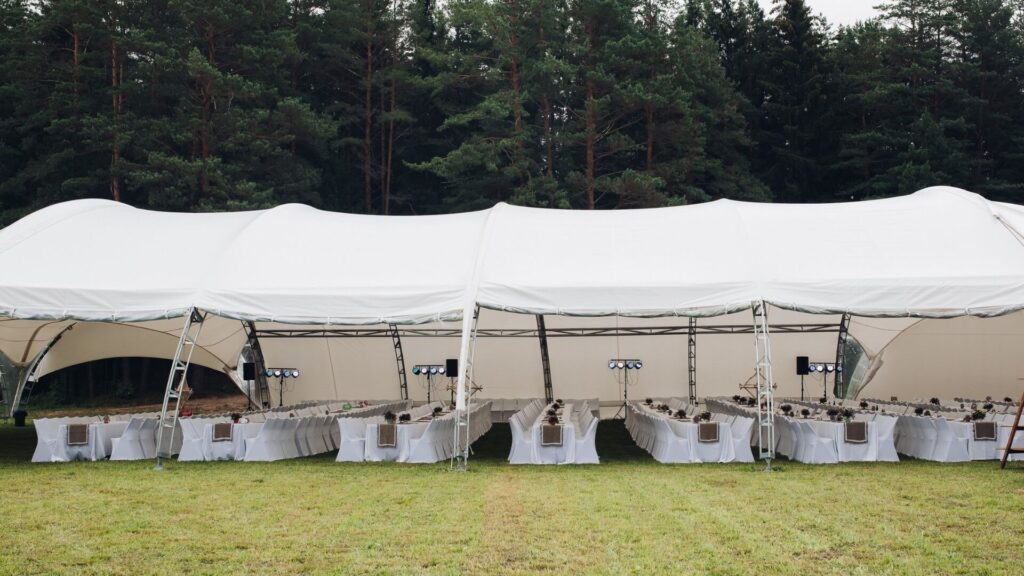
Trade fairs, exhibitions, celebrations, and sporting events require structures that can be installed in different locations and adapted to specific periods of use.
In these cases, tent tarpaulins contribute both to protection and to the space’s visual identity. Colour, finish, and customisation options can form part of the event’s image or the organising brand.
It is also important to consider ease of handling and the characteristics required for fabrication and assembly processes.
Coverings for industrial applications
In the industrial sector, tents can be used as storage spaces, work areas, or temporary extensions of existing facilities.
These applications often require materials selected according to more specific conditions of use. Strength, waterproofing, and durability become particularly relevant, as the covering must withstand the demands of the environment and the frequency of use.
Outdoor structures and seasonal solutions
Restaurants, retail businesses, and leisure spaces can use tents to expand service areas or create protected zones during certain seasons.
In these projects, the tarpaulin must integrate visually with the surroundings and provide the performance required for the intended use. The choice of finish and opacity level can also influence brightness and the experience of the people using the space.
Tent tarpaulins: The role of PVC-coated fabrics
Among the solutions used in the manufacture of coverings are PVC-coated polyester fabrics. This combination makes it possible to develop technical materials for different outdoor applications.
The polyester base provides a textile substrate, while the PVC coating delivers properties that are relevant for certain uses, such as waterproofing and surface protection.
Within this category, there are different constructions, weights, finishes, and performance levels. Selection will depend on factors such as the structure’s dimensions, environmental conditions, the fabrication system, and the intended period of use.
For example, a lightweight tarpaulin may be suitable for certain recreational tents, while a larger structure may require a fabric with different technical characteristics.
Tent tarpaulins: Expafol’s LONAFOL solutions for outdoor structures
At Expafol, we work with a range of technical tarpaulins designed to meet different needs in industry, camping, and textile architecture. Within this offering, there are different alternatives from the LONAFOL family that can be used in tents, awnings, and enclosures.
LONAFOL® 350 MATE L1 is a PVC-coated polyester tarpaulin with a matte finish. It is intended for applications such as camping, awnings, and lightweight tents. Its published features include waterproofing, UV resistance, and ease of handling.
Meanwhile, LONAFOL® 580 L1 has a double coating that provides strength and waterproofing. Its applications include awnings, camping, tents, and transport.
For projects that require a different type of performance, LONAFOL® 650 L2 is a technical fabric used in the textile architecture industry, especially for tents, awnings, and enclosures. Its construction incorporates a high-tenacity polyester base coated with PVC on both sides and a protective lacquer layer that makes cleaning easier and contributes to durability.
Another alternative is LONAFOL® BLACKOUT BO 780 L2, an opaque, flame-retardant technical fabric intended for outdoor solar-protection structures. Its applications include large tent and awning roofs, where opacity can also contribute to thermal comfort under the covering.
Each reference corresponds to specific characteristics and applications. For this reason, it is important to review the technical data sheet and assess the installation’s needs before defining the most suitable material.
Safety and durability: two aspects that must be planned
An outdoor structure must be conceived as a whole. The quality of the tarpaulin is important, but its performance also depends on the design, fastening systems, fabrication, and installation conditions.
Fabric selection must be made with the manufacturer’s specifications and the project’s technical requirements in mind. It is also necessary for the structure, anchors, and assembly systems to be sized for the intended conditions of use.
In installations exposed to wind, rain, or other demanding environmental conditions, the design and installation should be assessed by qualified professionals. In this way, decisions based solely on the material’s appearance are avoided, and all elements involved in the covering’s performance are considered.
Maintenance is also part of this planning. Following cleaning recommendations, periodically checking the condition of the fabric, and adhering to the manufacturer’s guidance helps maintain the tarpaulin’s performance throughout the intended period of use.
Design and functionality in a single solution
Technical requirements do not have to limit aesthetic possibilities. Today, tarpaulins for outdoor structures are available in different colours, finishes, and opacity levels, making it possible to adapt them to very different architectural and commercial concepts.
A tent can become a brand’s visual extension, integrate into the design of a hospitality space, or reflect the identity of an event venue. In each case, the material contributes to the experience you want to create.
This relationship between design and performance is especially important in professional projects, where the covering must fulfil a practical function while also contributing to the installation’s overall image.
Tent tarpaulins are essential components in the development of functional, long-lasting outdoor structures. Their selection requires analysing conditions of use, environmental factors, and the performance each application requires.
PVC-coated technical fabrics offer different options for meeting the needs of camping, events, industry, and textile architecture projects. However, selection should always be based on the material’s specifications and the specific requirements of each structure.
At Expafol, we develop and distribute technical textile solutions for different sectors, with a product range that meets the needs of each application. We invite you to follow us on LinkedIn to discover our latest news and projects, and to browse our previous articles to continue exploring the world of technical fabrics.